Tuesday, March 30, 2010

McNabb has Likely Reached Point of No Return in Philly

Fittingly, it has come to this. Always did seem as though Donovan McNabb was destined to be jettisoned out of Philadelphia under a cloud of controversy - which he had no part in creating. 


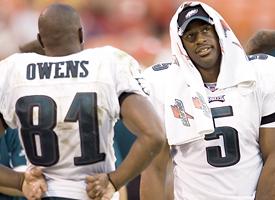
Eagles head coach Andy Reid announced on Jan. 11, his franchise quarterback would return for a twelfth season in Philly, seemingly squelching speculation about No. 5's future. Ten weeks later, McNabb's status for 2010 and beyond is anything but certain. Tune into ESPN and you won't have to wait long for the latest installment of Where in the World is Donovan Going. Sources throughout the Eagles' front office have consistently confirmed that the team is, in fact, entertaining trade offers for McNabb and seriously considering sending him packing. 

Perhaps most telling is that Reid has stayed predominately mum on the escalating issue. Big Red has only gone as far to say that several other NFL organizations have inquired about each of his three passers - McNabb, Kevin Kolb and Michael Vick. Reid also stated that he could see the Eagles bringing back the entire trio for training camp - though that seems far-fetched. All three are entering the final year on their respective contracts but each are currently at very different stages in their professional football careers. 


We all know Vick's story. The former Virginia Tech and Atlanta Falcons standout is still on the comeback trail after his kennel crimes and still has the ability to start for a handful of teams in the league. Kolb, who would likely take the reigns at starting QB if McNabb is dealt, is a 25-year-old with two career starts under his belt. When Philadelphia grabbed him at the top of the second round in the 2007 Draft, eyebrows were certainly raised. Despite being limited to ten games in 2006, McNabb compiled a sterling touchdown to interception ratio of 18 to six. However, production likely wasn't the determinant factor when Reid selected the former University of Houston star with the 36th overall pick. McNabb missed a total of 13 games between the 2005 and 2006 seasons and, despite being just 30 years old, there were questions about whether or not he could still make it through the grind of a full NFL season. So the Eagles went with the motto "better to be safe than sorry". 

McNabb answered critics by throwing for a total of 64 touchdowns and just 28 interceptions in the three seasons since Kolb was drafted. However, over that span there have been several events that ultimately helped lead to his current state of limbo. There was the 2008 tie with Cincinnati, after which McNabb surprisingly admitted he was not aware that an NFL game could end in a stalemate. The following week at Baltimore - with the Eagles offense sputtering - Reid did the unthinkable. McNabb was told to take a seat for the first time in his career. Kolb was inserted at quarterback for the second half and proceeded to throw a game-deciding interception, which was promptly returned 108 yards by Ed Reed for a Ravens touchdown. The fallout from the McNabb benching shook the football world until Reid announced that he was still going with the veteran as his starter the following week - a nationally televised primetime Thanksgiving game in Philadelphia.  McNabb responded by completing 27-of-39 passes for 260 yards, with four touchdowns and no interceptions in a 48-20 win over the Cardinals.

The Eagles traveled to Glendale, Ariz.,  to face the Cardinals again two months later - with a Super Bowl berth on the line. McNabb was at his finest leading Philadelphia during a memorable run to end the '08 campaign. Despite his up-and-down season, he helped the Eagles reach the playoffs for the seventh time in his nine seasons as a starter. He also set a career-high with 3,916 yards passing and led the Eagles to a franchise-record 416 points. Philly was considered by many to be the hottest team in the NFL when the playoffs rolled around. They confirmed those sentiments by knocking off both the Minnesota Vikings and the rival New York Giants on the road. 

But when McNabb emerged from the tunnel for the second half of the game in Glendale with his team trailing the Cardinals 24-6, it looked as though he would surely pick up the fourth NFC Championship loss of his career. The Eagles had thirty minutes of football left to reverse their fortunes and earn a second Super Bowl appearance in four years. Rumors were swirling that Philadelphia would undergo major changes in the offseason to follow. The futures of fanchise stalwarts John Runyan, Tra Thomas and Brian Dawkins were in doubt - even Reid and McNabb appeared to lack complete job security for the first time. 

Carrying the weight of the franchise's past failures on his shoulders, McNabb played arguably his best half of football as a professional quarterback. By the conclusion of the game, he would throw for 375 yards, with all three of his touchdowns coming in the second half. The last score - a 62-yard bomb to rookie DeSean Jackson - put the Eagles in front 25-24 with under eleven minutes remaining in the contest. The play would have become an iconic image of McNabb's greatest playoff moment to date but...

Kurt Warner and the Cardinals' offense answered by putting together a 14-play, 72-yard drive that took nearly eight minutes off the clock and resulted in 8 points. Down 32-25, Philadelphia got the ball back with under three minutes to play. The Eagles reached Cardinals' territory but could not find the end zone. Arizona advanced to the Super Bowl, while McNabb and Co. were left on the doorstep for the fourth time in seven years. 


The Eagles defense coughed up a back-breaking, game-winning drive to Arizona when it needed a stop the most. Yet, for some reason the game will always be chalked up as yet another big one that McNabb let slip away. The inescapable negative energy surrounding Donovan in Philadelphia has always been present - even during his five pro bowl years. He has secured just about every franchise passing record, been an upstanding citizen off the field and is one of the premier winners of his era. Yet, here is McNabb now - his services being linked to a new team each day. If there's any truth to the possibility of him going to the Oakland Raiders - who are not likely to extend his contract - then it's unfortunate. McNabb deserves better and, if his future is not in Philly, he has earned the right to land with a respectable franchise that does things the right way. 

Make no mistake about it - at 33 years old, McNabb is still one of the NFL's top 10 quarterbacks right now. His stats are favorable to those of Hall-of-Famer John Elway when examining the first eleven years of their respective careers:


McNabb: 32,873 yards / 216 touchdowns / 100 interceptions / 

   8 years with 80+ rating /  4 years with completion percentage over 60% /

  6 pro bowls / 3,249 rushing yards


Elway:  34,516 yards / 183 touchdowns / 167 interceptions /

 2 years with 80+ rating /  1 year with completion percentage over 60% /

5 pro bowls / 2,435 rushing yards


And Elway didn't own a Super Bowl ring until his 37th birthday. 


So now it appears that McNabb will be playing elsewhere in 2010, ending a run with the organization that made him the second overall selection out of Syracuse in the 1999 Draft. He's the only franchise quarterback that Reid has ever had - they both arrived in Philly the same season. I was always under the impression that Reid would be gone first or that he and McNabb would both be shown the door together (this appeared on the horizon prior to the team's brilliant '08 stretch run). But now it looks as though the head coach is ready to say goodbye to his star pupil and begin shaping his next one in Kevin Kolb. 

McNabb has always been a polarizing figure. He's been pegged as a terrific company man by some and a lap dog by others. Many love the way he's always smiling on the field - countless others despise it. Members of the media and the team's fan base often tried to pigeonhole him as an eratic-passing scrambler early in his career. That is until he developed into one of the league's best passers without having to leave the pocket - then they screamed he didn't run enough. His weapons have come and gone through the years, varying in their effectiveness. James Thrash was his No. 1 target for three seasons. Reid used his 2001 first-round pick to grab UCLA's Freddie Mitchell because he thought Fred Ex would be the perfect wide receiver for McNabb to grow old with. All-Pro receiver Terrell Owens arrived in Philly with fireworks, before swiftly exiting in the same fashion. Brian Westbrook was a loyal friend for many years, though injuries often limited his abilities. Duce Staley, LJ Smith, Todd Pinkston, Reggie Brown and Kevin Curtis all made cameos over the years. 

Funny thing is, McNabb has never had the kind of supporting cast that would await him in Philly in 2010. The young trio of DeSean Jackson, Jeremy Maclin and Jason Avant lead the deepest receiving corp the Eagles have had since McNabb's arrival. Brent Celek performed like a Pro Bowler last season and is the best tight end to play in Reid's offense. Throw in a three-headed monster in the backfield - featuring LeSean McCoy, Mike Bell and Leonard Weaver - and you've got the makings of an extremely explosive offense. 

On one hand, it makes sense for Philly to carry on with the youth movement, hand the keys to Kolb and give him a shot at leading the next generation of Eagles players. But I get the impression that the organization's decision-makers are talking themselves into trading their franchise player for the wrong reasons. Maybe it's an obligation of the front office to "stick to the plan" it established in '07 when the team added Kolb and McNabb's health was suspect. Or perhaps Reid has finally grown weary of answering all the questions about No. 5's future and is ready to move on. Whatever the case is, I have a very hard time convincing myself that the Eagles are better equipped for a run at a championship by dumping McNabb - and that's all that matters. Kolb is a great unknown. McNabb is as close to a sure thing that the NFL offers.


If this is the end of an era in The City of Brotherly Love, I'll look back on McNabb's years in Philly as one of the most successful franchise runs in recent league history. Over the past 20 years, only the Packers, 49ers, Colts and Patriots have enjoyed as consistent a decade as the Eagles. Unfortunately, five NFC Championship games equated to just one Super Bowl  appearance - in which the Eagles narrowly lost to one of the NFL's all-time greatest teams.


 People from outside Philadelphia have always wondered aloud how a city could at times be so brutal to its greatest sports star. Upon his arrival, McNabb immediately entered a hornet's nest due to Philly's football title drought - the Eagles have not won a championship since 1960. The team's excruciating flirtation with greatness during McNabb's tenure has only made fans more cynical. They've spent so much of the past eleven years expecting the worst that it has often cost them the ability to appreciate McNabb, the second greatest field general to direct the West Coast offense since Joe Montana - behind only Brett Favre and ahead of Steve Young. 

Philadelphia still could have a change of heart, decide to reel the QB back in from the trading block and let him return to the only NFL home he's known. At this point though, why would he want to?


Thursday, March 25, 2010

Every Super Bowl Ending Begins on Draft Day


It's that time of year again. March Madness is in full force, women have resumed wearing skirts and the boys of summer are on the verge of making meaningful swings once more. Yet the National Football League, as usual, manages to grab at least a share of the spotlight.


The NFL draft has become a phenomenon over the years. When it began in 1936, the selection of eligible college football players by professional franchises received limited fanfare. There were no articles written about how many bench presses a prospect could do. There were no egomaniacs, adorned in cheesy suits and overdone hairdos, shouting out reasons why or why not a collegiate quarterback's style of play would translate to the next level. At its origin, the professional football draft got about as much publicity as the WNBA Draft receives today.


Times have changed, my friend. We're now less than a month away from the most anticipated offseason tradition in sports - Ben Roethlisberger's annual late night bar exploits are a close second. But bite your tongue before you call the NFL draft overhyped or overrated. Sure, the pomp and circumstance of the event can be a bit much for even the most zealous fan. But it's undeniable that the most crucial pieces of the championship puzzle are found on draft day.


Take a look at the premier franchises of the past decade - New England, Indianapolis, Philadelphia and Pittsburgh - as an example of what efficient and intelligent drafting can do for you. It's made Eagles head coach and roster-builder Andy Reid a ton of money. Big Red has used the annual crop of college talent to consistently replenish his squad since he was hired in 1999. It's the reason his Eagles have avoided the dreaded "rebuilding" phase that has beset so many former perennial playoff teams (San Francisco, Miami, Tampa Bay, Oakland, etc.). Philadelphia added foundation players like Donovan McNabb, Brian Westbrook, DeSean Jackson, Sheldon Brown, Trent Cole and Shawn Andrews - the man formerly known as an All-Pro guard - on draft day. Of the 22 players to suit up for the Colts in the Super Bowl this year, 16 of them were snatched out of college by Indy. Free agency can provide the final missing factors to a championship team, but the draft is where franchise fortunes are founded.


On the flip side, bad drafting can doom a team and its coaching staff. Ill-advised selections can quickly send a team on a downward spiral and ultimately cost an entire front office its jobs. Devastating draft busts are like dark clouds over an organization, and they tend to linger far too long. You don't have to look very far back in the rear-view mirror to be reminded of how horribly wrong things can become when a franchise "savior" fails to deliver.

The Raiders, an organizaton that once glimmered with prestige, have become an annual punch line (no pun intended, coach Tom Cable). Long forgotten are Oakland's glory days, when the team collected three Super Bowl championships between 1977 and 1983. Heck, it's hard to recall the team even being respectable since it's embarrassing 48-21 Super Bowl loss to the Buccaneers in 2003. How have things turned so ugly so fast? Well for starters, the same man who put the roster together in '77 is still at the helm over thirty years later. The legendary Al Davis is one of two NFL owners who ultimately has the final say on draft day - Dallas' Jerry Jones is the other - but this is no longer the sharp-witted mastermind that assembled teams with John Madden during the disco era. His eye for fashion remains the same, but his eye for talent and character has unquestionably eroded.


Here's a quick look at Oakland's recent first round flops:


2009: Darrius Heyward-Bey, wide receiver, Maryland - seventh overall selection

As usual, Davis fell in love with speed (Heyward-Bey ran a 4.3 40) and reached for a guy most teams had dropping out of the top 20 picks. During his rookie campaign, the receiver failed to shed the "questionable hands" tag that scared off many teams leading up to the draft. Heyward-Bey caught just nine passes in 11 games, while getting paid handsomely for it. Davis opted to pass on Texas Tech wide receiver Michael Crabtree, who appeared to have the makings of a star after ending his lengthy holdout in San Francisco.


2008: Darren McFadden, running back, Arkansas - fourth overall selection

While McFadden will be just 23 years old on opening day next season, he hasn't come close to warranting his high selection. Run-DMC was electric in college and was at the forefront of the "Wild Cat" craze, but has tallied just 856 yards and five touchdowns in two seasons as a Raider. Injuries have cost him seven total games thus far and he will have to compete with Michael Bush for Oakland's starting running back gig in training camp. McFadden could still turn out to be a solid investment, but the fact that both Chris Johnson and Ray Rice were taken much later in the '08 draft makes his slow start tough to handle for Raider nation.


2007: JaMarcus Russell, quarterback, Louisiana State - first overall selection

This one is just brutal. In Russell, Davis thought he was getting a big, strong leader with a championship pedigree and football's most powerful throwing arm. Instead, he gave $29 million guaranteed to a Jared Lorenzon wannabe. Russell looks more like a backup offensive tackle than a franchise quarterback these days and when September rolls around he is likely to find himself at No. 2 on the depth chart behind... drum roll please... Bruce Gradkowski. In 31 appearances, the Pillsbury Throwboy has completed just 52 percent of his passes for 18 touchdowns and 23 interceptions. When it comes to draft busts, Russell is an all-timer. Players the Raiders could have taken instead of Russell include Adrian Peterson, Patrick Willis and Darrelle Revis. Ouch. That is a sweet fur coat though.


2006: Michael Huff, safety, Texas

- seventh overall selection

Does this feel like the movie Groundhog Day or what? Just a cycle of letdowns repeating itself. Much like a Greek tragedy - you know how it ends but you can't turn your eyes away. Huff was primarily a starter during his first two seasons but has since been benched and relegated to rotational duty. Not exactly what you're looking for from a top-10 selection. Oakland nabbed Huff early because they believed he would give the defense a boost as a relentless playmaker. Huff's four career interceptions show otherwise. It's not like Pro-Bowlers Jay Cutler, Haloti Ngata or DeAngelo Williams (all passed over for Huff) could've helped the Raiders win more games or anything.


If the names Napoleon Harris, Tyler Brayton and Derrick Gibson aren't familiar to you, that's because they shouldn't be. They're just a few more of Oakland's first round selections from the past decade that fell by the wayside. There is a reason why teams are consistently awful - poor decisions on draft day. Between 2002 and 2005, the Detroit Lions chose first-rounders Joey Harrington, Charles Rodgers, Mike Williams, Kevin Jones and Roy Williams as the pillars of the franchise. By 2008 the only thing left was rubble and the Lions became the first team in NFL history to finish a season 0-16. Coincidence? Not a chance. Clearly, the NFL draft is a make-or-break event. Grab a quarterback in the top 10 and you could end up with a franchise-changer like Peyton Manning or Troy Aikman. But you always risk stepping on a landmine and taking the next Akili Smith or Ryan Leaf.


As for the upcoming draft, things are beginning to take shape with multiple teams providing a glimpse of their draft plans through moves in free agency. The NFL combine has come and gone - 40 times checked twice for good measure - and prospects will continue to flaunt their stuff at personal workouts as April 22 nears. This isn't baseball, in which even the best draft prospects take years before they contribute in the big leagues. The NFL is a win-now business and every pick carries weight. For a head coach or general manager, it can mean the difference between a multimillion dollar extension and a pink slip. For a franchise, the draft can either help a team turn the corner or make the bottom fall out for years to come.


Still think you have the cojones to be a decision-maker in the National Football League?


STAY TUNED to TD's TAKE FOR THE LATEST NFL DRAFT NEWS...

Monday, March 8, 2010

Da Bears Dominate Headlines with Bold Moves


Bears head coach Lovie Smith and general manager Jerry Angelo are fully aware that their jobs are on the line this year. Prior to last season, Sports Illustrated predicted Chicago would play in the Super Bowl. However, those expectations quickly evaporated into a pipe dream as the team never looked better than average. Quarterback Jay Cutler - the prize of the '08 offseason - led the NFL with 26 interceptions, while throwing the ball to a converted defensive back and a group of inexperienced wide receivers. The Bears finished third in the NFC North with a very disappointing 7-9 record and many questioned whether Smith and Angelo would be handed their walking papers.

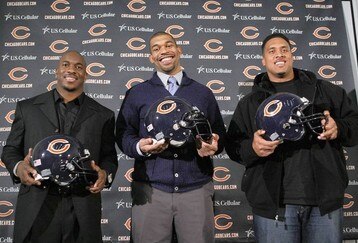
Chicago's owners opted to give the duo one last shot at turning the Bears into contenders. They also provided Angelo with a large budget to allow the general manager to pursue immediate impact players. The Bears quickly pounced on Carolina Panthers defensive end Julius Peppers on Friday, the first day of free agency. The feared sack artist made Chicago the first visit on his free-agent tour and the Bears gave him 42 million guaranteed reasons to make it his last. Before the ink could dry on Peppers' new six-year/$91.5 million contract, the Bears signed versatile tight end Brandon Manumaleuna and stole veteran running back Chester Taylor from the rival Vikings.

As international spy Austin Powers would say, "Whoopdeedoo. What does it all mean, Basil?" Well for one, it gives the Bears their most formidable pass rusher in recent memory. Peppers has been one of the best at knocking down the quarterback for a decade, but you've got to wonder how many productive years the 30-year-old has left.

I could see this playing out much like Jevon Kearse's tenure in Philadelphia. "The Freak" was 27-years-old when he signed a lucrative contract with the Eagles in 2004 and he didn't disappoint - at first. Kearse totaled 15 sacks during his first two years in Philly - solid, but not great numbers for a guy who averaged close to 10 sacks per season during his five years in Tennessee. Over the span of his final two campaigns with the Eagles - 2006 and 2007 - Kearse picked up just seven QB takedowns and was beset by injuries. The 1999 NFL Defensive Rookie of the Year only displayed his potential greatness in flashes during his four-year stay in Philadelphia and was released by the team following the '07 season.

Nothing against Peppers - the man has 25 sacks in the past two years - but defensive ends can lose their edge very quickly. Once a speed rusher gets a step slower, particularly on their initial explosion, offensive tackles can begin to catch up.

The addition of Manumaleuna makes sense because of his ties to new Bears offensive coordinator Mike Martz. The tight end was a member of the Rams when Martz was guiding the team's offense during the "Greatest Show on Turf" era. Martz's scheme almost exclusively features three receivers and restricts the tight end to pass protection duties on most plays. This sets up an interesting situation with incumbent starting tight end Greg Olsen, who was Chicago's first-round draft choice in 2007 and is coming off the best season of his career. Rumors have circulated that the Bears could be dangling Olsen as trade bait, but it's hard for me to believe Martz isn't clever enough to develop a game plan that incorporates one of the team's top playmakers.

Chicago is banking on Taylor to bolster its backfield and help take some of the load off third-year running back Matt Forte's shoulders. Forte is fresh off a sophomore slump and the Bears are desperate for offensive help, so acquiring the 30-year-old running back is a slick maneuver. He's been a quality No. 2 back for most of his career and should be a solid mentor to Forte. When Taylor left Baltimore to join the Vikings in 2006, he became a featured running back for the first time in his professional career. He was very productive as the go-to guy - rushing for over 1,200 yards, while carrying the ball an average of 20 times per contest in '06.

Just months after his breakout season, the Vikings nabbed Adrian Peterson when he slid to them on draft day. Taylor's starting gig in Minny was quickly yanked away but he adjusted and became a terrific supplemental back to Peterson. Taylor proved to be both an effective blocker and reliable pass catcher - two attributes you look for in a third-down back. I expect he'll assume similar duties in the Windy City, while keeping his eye on the starting job should Forte falter.

The Bears spent over $100 million for their three newest players on the first day of free agency and have officially gone 'all-in'. Unfortunately, Angelo has yet to address the team's two most glaring needs - offensive line and wide receiver. The franchise has invested a lot in Cutler. Now it needs to provide him with the pieces to be successful or he could ultimately join the lineage of failed Bears quarterbacks.

Cutler owns arguably the best throwing arm in football - his decision making may be in question, but his talent never is. Now in Martz's pass-heavy offense, Cutler could develop into one of the game's premier passers with the right weapons. The ridiculously speedy Devin Hester remains a rather raw talent at receiver. Hester was a cornerback and kick kick returner for the Bears until last season, when he had 57 receptions for 757 yards and three touchdowns. Martz believes Hester is best suited to fill the role of slot receiver, where Az-Zahir Hakim flourished as the No. 3 target behind Torry Holt and Isaac Bruce in St. Louis. If Chicago hopes to have a legitimate championship-caliber offense in 2010, the team needs to find at least two receivers that are better than Hester.

The Bears are without a first- or second-round pick in April's draft (casualties of trades for Cutler and the late Gaines Adams) so they'll have to find productive wideouts on the free agent market or hope that someone on the current roster emerges. Devin Aromashodu, a four-year veteran out of Auburn, looked promising toward the end of the 2009 campaign. He developed into one of Cutler's favorite targets, hauling in 22 of his 24 total receptions and scoring all four of his touchdowns after November. Chicago's coaching staff is high on Aromashadu and he will likely enter training camp as a starter.

Left tackle Orlando Pace was just a shell of his former All-Pro self last season and was cut by the Bears this winter. It's imperative that Angelo upgrades the tackle position to keep Cutler's jersey clean and locates a receiver who provides the quarterback with a reliable weapon. Veteran receivers Terrell Owens and Derrick Mason could do the trick, but former Buccaneer Antonio Bryant is a more suitable fit.

Unless Chicago addresses these two pivotal positions, its spending spree will likely be all for naught. The Bears' air attack will remain grounded and the team will stay squarely behind division foes Minnesota and Green Bay. For a franchise that has dominated the headlines early in free agency, there is still much to be done.


More on the NFL to come...

Stay tuned to TD's Take for the latest league-altering moves.

Examining the New Era of NFL Roster Building


Professional football's version of musical chairs is officially under way. NFL free agency began on Friday and also opened the door for the potential of a bevy of trades. Due to the large number of restricted free agents - a result of collective bargaining squabbles between the players union and the league - the offseason environment has never been as conducive for wheeling and dealing as it is right now.


Numerous restricted free agents and their respective teams are in a bit of an awkward situation. Until this year, many of these players anticipated becoming unrestricted free agents - which gives an athlete the ability to sign with any team he'd like without interference from his most current employer. However, with a labor agreement no where in sight, these players' futures are still controlled by their current franchises.


Here's a quick overview of restricted free agency for those who don't delve into the business side of the NFL:


* Until now, a player who had five years of experience under their belt was eligible for unrestricted free agency, but that has now been pushed back to six seasons. Therefore, four-year veterans who were selected by their current team in the 2005 draft - i.e. Shawne Merriman, Braylon Edwars and Cadillac Williams - are still property of that franchise.


* Teams have the option to extend one of four particular one-year tenders to a restricted free agent. The club then has the ability to either block the player from signing elsewhere by matching the offer, trade the player, or work on a long-term contract with the player.


* Depending on the one-year salary offered to a player, there is correlating compensation that the team would receive if its restricted free agent joined another franchise. The scale is broken down like this:


1) Signing a player holding a $2.562 million tender from their current club requires first-and third-round draft pick compensation, which is rewarded to the player's former team.

Example: Dallas wide receiver Miles Austin


2) Signing a player holding a $2.017 million tender requires a first-round pick as compensation.

Example: Denver wide receiver Brandon Marshall


3) Signing a player holding a $1.417 million tender requires a second-round pick as compensation.

Example: New York Jets running back Leon Washington


4) Signing a player holding a $927,000 tender requires the player's original draft status. (A former fifth-round pick would cost his team its current fifth-round pick)

Example: Miami Dolphins tight end Anthony Fasano, a former second-round choice


Remember, teams can still work out deal and negotiate a player's trade value as they see fit. Expect to see a lot of this in the coming weeks. Not every restricted free agent will be welcomed back to their 2009 team with open arms because they may no longer fit in the long-term plans of their franchise, which may have been counting on them hitting the market after their fifth season.


Okay, enough about the technicalities of free agency - this is more business and math than I'd care to include in a sports column and frankly, it's giving me a headache.


Let's move on to the important stuff and take a look at which players have changed teams so far and how recent roster moves will affect the NFL landscape...

Friday, March 5, 2010

Girls Gone Wild


First off, sorry if the title is a tad misleading - unfortunately we will not be journeying to Cancun.

Baylor's freshman phenom, Brittney Griner, was apparently having a bad day yesterday. During her team's 69-60 win over Texas Tech, Griner threw a haymaker that would make Hilary Swank proud. She landed a punch to the face of Tech's Jordan Barncastle, breaking her nose and surprising everyone watching.


Griner was immediately ejected and has since been suspended for two games. The penalty seems a bit light to me. A suspension of five games or more would have been more appropriate.

Think back to last football season, when Oregon running back LaGarrette Blount punched an opponent following a loss. Blount was put on trial by fans and media across the country and suspended for the entire season (later reduced). Had Griner received a punishment similar to Blount's, it would have effectively put an end the the star's freshman season and annihilate any national championship ambitions for No. 14 Baylor.
Griner is a 6-feet-8-inch prodigy. She was one of the most heralded recruits ever coming out of high school last year and is averaging 19 points, 8.7 rebounds and 6.1 blocks per contest. She already owns the Big 12 single-season blocks record.

Griner was an Internet sensation before she even set foot on Baylor's campus - highlights of her dunking during high school gained publicity. This season, she became just the second woman ever to dunk during a college basketball game (the first was Candace Parker). As long as she stays healthy, Griner should be the first overall pick in the WNBA Draft someday and become one of the legends of women's basketball.

But if Griner aims to become a marketing machine for Nike or Reebok - i.e. Lisa Leslie, Parker- she would be wise to never do anything like this again.

Monday, March 1, 2010

Why You Should Appreciate the NFL's Ultimate Supervillan


He's the only player to score a touchdown against all 32 NFL teams, reaching the end zone at least twice against 31 of them. Of the thousands of athletes who have stepped onto a professional football field, he's among the all-time greatest playmakers and is arguably the most entertaining. And I'm guessing you probably hate him.

I'm talking about you-know-who, Mr. Sharpie, The Popcorn Man, The Pharmacist, The Situation - Mr. Terrell Eldorado Owens. Yes, his middle name really is Eldorado. The man everyone loves to root against is once again in search of a new babysitter... ahem, I mean team.


The Buffalo Bills announced over the weekend that they have no intentions of offering Owens a contract for next season because he is no longer part of the franchise's long-term plans. Nor should he be, with the Bills set to begin yet another roster overhaul in their agonizing, never-ending rebuilding process. When you're looking to reboot your roster in the National Football League, 36-year-old receivers usually don't make the cut. Change is needed for Owens as well. T.O. had by far his worst statistical season since his rookie campaign in 1996, hauling in just 55 catches for 829 yards, while scoring six times.

But let's be fair here - for the first time since he had Tim Rattay throwing him the ball, it REALLY was the quarterback's fault. The Bills were banking on a breakout season from QB Trent Edwards, the team's third-round draft choice in 2007. The offensive game plan and Owens' productivity relied heavily on the young quarterback developing into a legitimate NFL starter. Edwards failed to progress and was benched in favor of backup Ryan Fitzpatrick by season's end. The Bills slumped their way to 6-10 and head coach Dick Jauron was canned at the end of the season. Yes, T.O.'s brief stay in upstate New York was a failure, but Owens was just a passerby on a seemingly cursed team.


So now the receiver will take his show (literally) elsewhere and play for his fifth franchise, the fourth since 2005. Don't expect Owens' free agency to be nearly as publicized as in years past because, whether he likes it or not, T.O. simply isn't the celebrity he once was. Maybe it was his awkward exit from Dallas or simply his year of exile in Buffalo, which nearly half of NFL fans think is a province in Canada. Whatever the matter is, Owens' star has rapidly dimmed.


Owens has always demanded constant media coverage. He's been ratings gold because, no matter what comes out of his mouth, sports fans across the country will be talking about it at work, school or the bar. But recently, his sound bytes began to fall upon deaf ears. We've grown tired of listening to what No. 81 had to say. He's become football's equivalent of "Manny being Manny". We no longer dissect T.O.'s musings or take delight in his frequently annoying mannerisms. Instead we greet Owens' antics with a shoulder shrug and a roll of the eyes, because a joke is only funny the first few times you hear it.


Since he burst onto the NFL scene, Owens has always had a flair for the dramatic. He sobbed after snagging a game-winning touchdown pass from Steve Young in the final moments of the 49ers' classic wild card win over the Packers in the 1998 playoffs. He entered the national consciousness with that catch and gave San Francisco a glimpse of what life after Jerry Rice looked like. During a 2000 matchup at Dallas, Owens followed up a touchdown by sprinting to midfield and posing on the star logo of the Cowboys - twice. The second time he was cracked by Dallas' George Teague but T.O.'s message was sent and he became a household name.

Sharpie got free advertising when Owens pulled a marker out of his sock after a touchdown and autographed the football during a 2002 Monday night game in Seattle. He then handed it to a man sitting in an end zone luxury suite rented by Shawn Springs, the cornerback he'd just burnt for the score. Owens has also grabbed and used a cheerleader's pom-poms, mocked the "Ray Lewis dance", and worked on his abs with sit-ups in various touchdown celebrations over the years.


When Owens was shipped across the country to Philadelphia in 2004, the balance of power in the NFL shifted. Philly finally had a legitimate No. 1 receiver for Pro Bowler Donovan McNabb to target. The Eagles didn't just substantially improve their receiving corp, which featured "legends" like James Thrash and Todd Pinkston, they added one of the league's dominators. Owens could change the dynamics of a game at any moment and immediately added attitude to Philly's offense. For one season, the Eagles-Owens marriage was a triumph. Philadelphia cruised to the best record in the NFC and Owens set a single-season franchise record for 100-yard games (seven) and scored more touchdowns (14) than any Eagles player since 1945.


That year, the Eagles finally broke through their NFC title game barrier and reached the Super Bowl for the first time since 1980. Though Owens missed the final two games of the regular season and first two contests of the playoffs with a severely sprained ankle and fractured fibula, he shocked many by returning for the Super Bowl. He caught nine balls for 144 yards and a touchdown in the Eagles' 24-21 loss to New England. Owens had a noticeable limp throughout the game but refused to be denied his shot at winning a championship on the world's biggest stage.

We all now how ugly things turned for T.O. in Philly. Names were called, punches were thrown (courtesy of former Eagles defensive end Hugh Douglas) and eventually Owens was released by Philadelphia after just his second season into a seven-year, $49 million contact. At the height of his stint with the Eagles, Owens was one of Philadelphia's most beloved sports figures of the past few decades. Fans were ready to erect his statue after year one of his stint in the City of Brotherly Love. A year later, he was practically run out of town by an angry mob. McNabb never seemed to recover from the negative attention and controversy that Owens brought to the Eagles' locker room in 2005. Neither has T.O.


Owens wound up with Dallas and enjoyed three successful, but tumultuous, seasons. He again shattered team chemistry and brewed up trouble, this time with teammates Tony Romo and Jason Witten. Jerry Jones pulled the plug on the T.O. experiment last spring. He now finds himself in similar circumstances, just another year older.


His situation is an interesting one. Despite his drop in numbers last season, Owens is still capable of being the go-to receiver on many teams. He has tallied at least 1,000 receiving yards in eight of the past 10 seasons, while averaging over 11 touchdowns per year in that span. Wide receivers rarely hit the wall overnight like running backs do. They typically make a gradual decline toward the end of their careers or succumb to injuries. Considering Owens has missed only one contest since 2005, it's safe to say that he has maintained his health and has more in the tank.


Now we come to the question at hand. Which team will invest in the future Hall of Fame wide receiver? It will likely take only a one-year deal to acquire Owens' services and sideshow act. Odds are, a contending franchise that is one playmaker short will take a shot. The Ravens are rumored to be interested, though it's hard for me to see the proud franchise welcoming a guy who once spurned a trade to Baltimore. Each of the three Florida teams could make a play for Owens. Jacksonville is desperate for star power, while Miami and Tampa Bay both have young quarterbacks devoid of a No. 1 target. Believe it or not, don't count out a reunion tour in San Francisco. Stranger things have happened - like Owens celebrating on the Cowboys' star in a Dallas uniform.


From my perspective, he's got to go to a team with an established quarterback who can hold his own in a relationship with Owens. Pair T.O. with a young, unsure passer like Josh Freeman or Chad Henne and you could have trouble on your hands. My guess is Owens returns to the West Coast and unites with veteran QB Matt Hasslebeck in Seattle. New head coach Pete Carroll will attempt to make a one-year run at a championship with the team he's inherited before blowing the whole thing up, which means Owens could be worth the gamble.


No matter where he winds up, one thing is for certain - we will pay more attention to whichever team signs him than we did beforehand - because we can't take our eyes off T.O. Whether he's on or off the field, Owens always puts on a performance.


He's one of the greatest football players we've seen, currently ranking fifth in NFL history in touchdowns (147), sixth in receptions (1,006) and third in receiving yards (14,951).


I implore you to end the hate fest. Don't waste your time despising a living legend who's never been arrested, written a children's book ("Little T Learns to Share") and made you laugh at least once. Deep down you have to admit that you kind of like that Owens isn't one of the many NFL players in the cookie-cutter mold that commissioner Roger Goodell's new policies have created.


T.O. has always been an individual in the most team-oriented sport on the planet. He's always been recognizable in a game that hides its players behind face masks. Yes, he can be self-absorbed and arrogant enough to give you a stomach ache, but do yourself a favor and watch Owens' highlights with mute on. No cocky comments, no controversial crunches, no popcorn necessary. Just one of the most dominant athletes to play his sport - burning safeties, bowling over cornerbacks and scoring lots and lots of touchdowns.

Everything else is just Terrell being Terrell.